Does the 2048 Corner Strategy Actually Work? We Let Bots Play 61,200 Games
Every 2048 guide says to keep your biggest tile in a corner, ours included. Most players will tell you it helps. We wanted to know how much, and whether the corner itself is what helps or whether it’s standing in for something else.
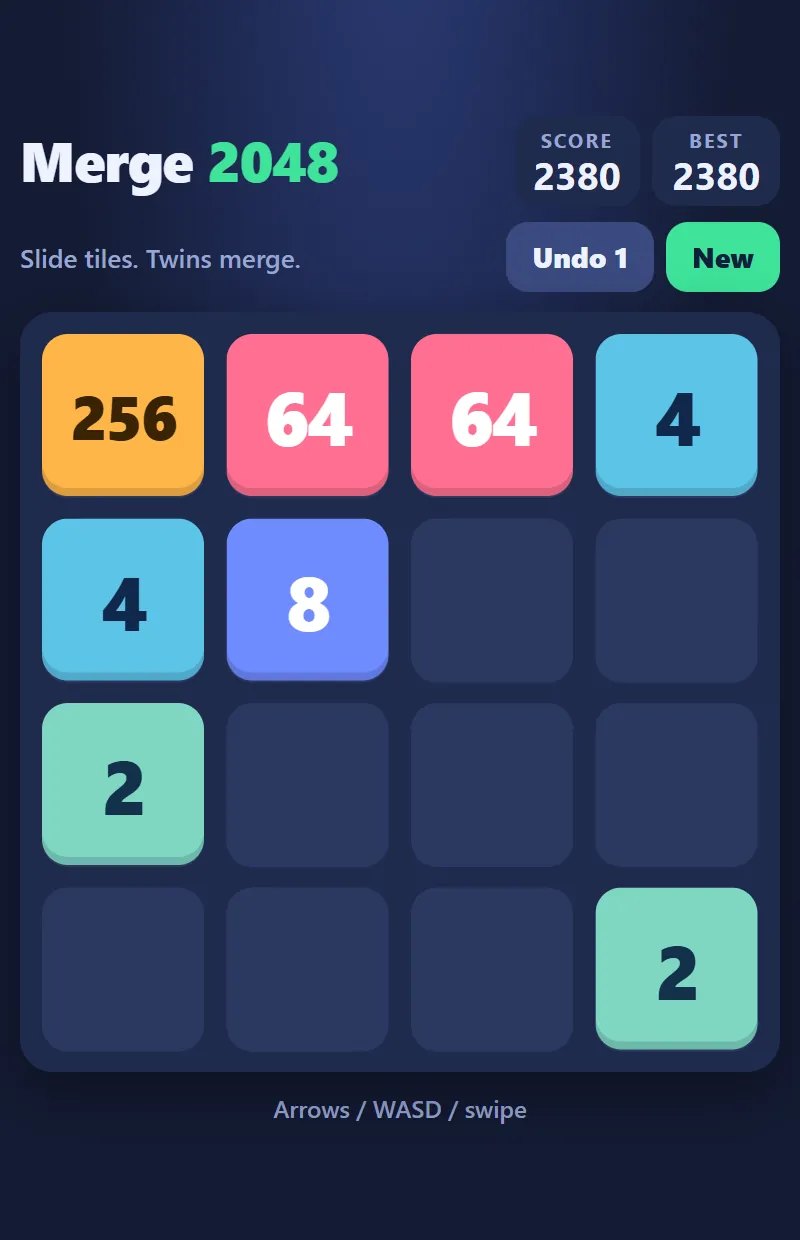
So we took the game logic out of our Merge 2048 and ran it without graphics. Same rules as the page: 4x4 board, two starting tiles, each new tile a 2 with 90% probability and a 4 otherwise, dropped into a random empty square, score equal to the sum of every merged tile. Then we wrote four bots and let each one play until it had no legal move. None of them use undo, and they keep going after 2048, as you can.
The bots
- Random. Picks a random direction that actually moves something.
- Fixed corner. Follows the practice routine from our guide to the letter: down if that moves anything, otherwise left, otherwise right, and up only when nothing else works. It never looks at the board.
- Corner with a glance. Tries every legal move and looks at the board each one produces, before the new tile appears. It strongly prefers moves that leave the biggest tile in the bottom-left corner, and among those picks the one with the most empty squares. Ties go in down, left, right, up order.
- Planner. Looks two moves deep. For each move, it imagines every square the next tile could land in, as a 2 and as a 4, and picks its best reply to each. It scores boards on how well they form a “snake”: big tiles in the bottom-left, values stepping down along the bottom row and winding back along the row above. That’s the chain shape from our guide.
Bots 1 to 3 played 20,000 games each. The planner is much slower (one game runs past 1,800 moves), so it got 1,200. We then reran bots 1 to 3 with a different random seed, another 20,000 games each, and no percentage below moved by more than a point.
Results
Share of games in which the bot built at least the given tile:
| Bot | Games | 128 | 256 | 512 | 1024 | 2048 | 4096 |
|---|---|---|---|---|---|---|---|
| Random | 20,000 | 55.3% | 7.9% | 0.02% | 0% | 0% | 0% |
| Fixed corner | 20,000 | 90.3% | 50.8% | 4.6% | 0.01% | 0% | 0% |
| Corner with a glance | 20,000 | 95.8% | 76.1% | 21.3% | 0.2% | 0% | 0% |
| Planner | 1,200 | 100% | 99.5% | 98.1% | 95.0% | 79.7% | 28.1% |
Scores and game length:
| Bot | Median score | Average score | Average moves |
|---|---|---|---|
| Random | 1,048 | 1,096 | 118 |
| Fixed corner | 2,428 | 2,539 | 225 |
| Corner with a glance | 3,356 | 3,556 | 287 |
| Planner | 35,348 | 37,201 | 1,846 |
The small percentages are small counts. Random play made a 512 in 3 games out of 20,000. The fixed corner bot made a 1024 twice, the glancing bot 37 times. Across 60,000 games, none of the three simple bots ever built a 2048.
Reading the gaps
Bot 1 to bot 2: the rule alone
Pressing down-left-right-up in a fixed order more than doubles random play’s median score, and reaching 256 becomes about six times as likely (50.8% against 7.9%). For a rule that never looks at the board, that’s a lot. Leaning on two directions keeps the tiles packed against one side, so equal tiles end up touching more often.
It also hits a ceiling around 512. The fixed bot follows the corner rule perfectly and still loses because it has no idea what a move will do. It pressed down 70% of the time and up only 0.1% of the time. Even so, in a separate 10,000-game check, only 67.7% of its games ended with the biggest tile in the corner. Pressing buttons in order doesn’t protect the corner. It just loses the corner less often.
Bot 2 to bot 3: looking first
The glancing bot has the same corner preference but checks each move’s result before committing. That one check lifts 512s from 4.6% to 21.3% of games and adds about 900 to the median score. In the same 10,000-game check, its biggest tile finished in the corner 88.9% of the time.
And it still reached 1024 in only 0.2% of games. A big tile in the corner plus lots of empty squares isn’t enough if the tiles next to the corner are in the wrong order.
Bot 3 to bot 4: order and lookahead
The planner is the only one that wins reliably: a 2048 in 79.7% of games, a 4096 in 28.1%. It differs from the glancing bot in two ways.
It scores the order of the tiles, not only where the biggest one sits. A stray 2 wedged next to a 256 makes a bad board even when the 256 is in the right place.
It also thinks about where the next tile might land. Some moves look fine and leave exactly one empty square beside the corner. A 2 lands there and the chain is ruined. Checking every possible spawn catches those.
Both are habits our guide already recommends: keep a descending, snaking chain, and watch where new tiles appear. In these runs they mattered far more than the corner did. The corner gives the chain somewhere to start. Getting to 2048 took the other two.
Why people do better than bots 2 and 3
The fixed-order bot is easy for a person to beat. Even a beginner sees “if I press right, my 256 slides out” and doesn’t press right. That bit of looking ahead is the whole difference between bot 2 and bot 3. Doing it a couple of moves deep is most of the difference between bot 3 and bot 4.
What to take into your next game
- Use a corner. Even with no thought behind it, it doubled the median score over random play.
- Picture the board after a move before you make it. In our runs that habit was worth more than the corner rule.
- Look after the order of the chain, not only the corner tile. The bots that only guarded the corner stalled at 256 and 512.
- Ask where the next tile could drop. If a move leaves one lone gap beside your chain, expect a 2 there.
- Expect long games. The planner averaged 1,846 moves.
A score above 3,356 beats the median of the glancing bot. A 2048 puts you with the planner. Merge 2048 keeps your best score in the browser, so you can check over a few games.