How Often Does a Classic Mine Board Force You to Guess? We Measured It
Play mine-sweeping puzzles long enough and you hit the spot where the numbers stop helping. Two covered squares look exactly the same, and you click one and hope. Was that on you, or on the board?
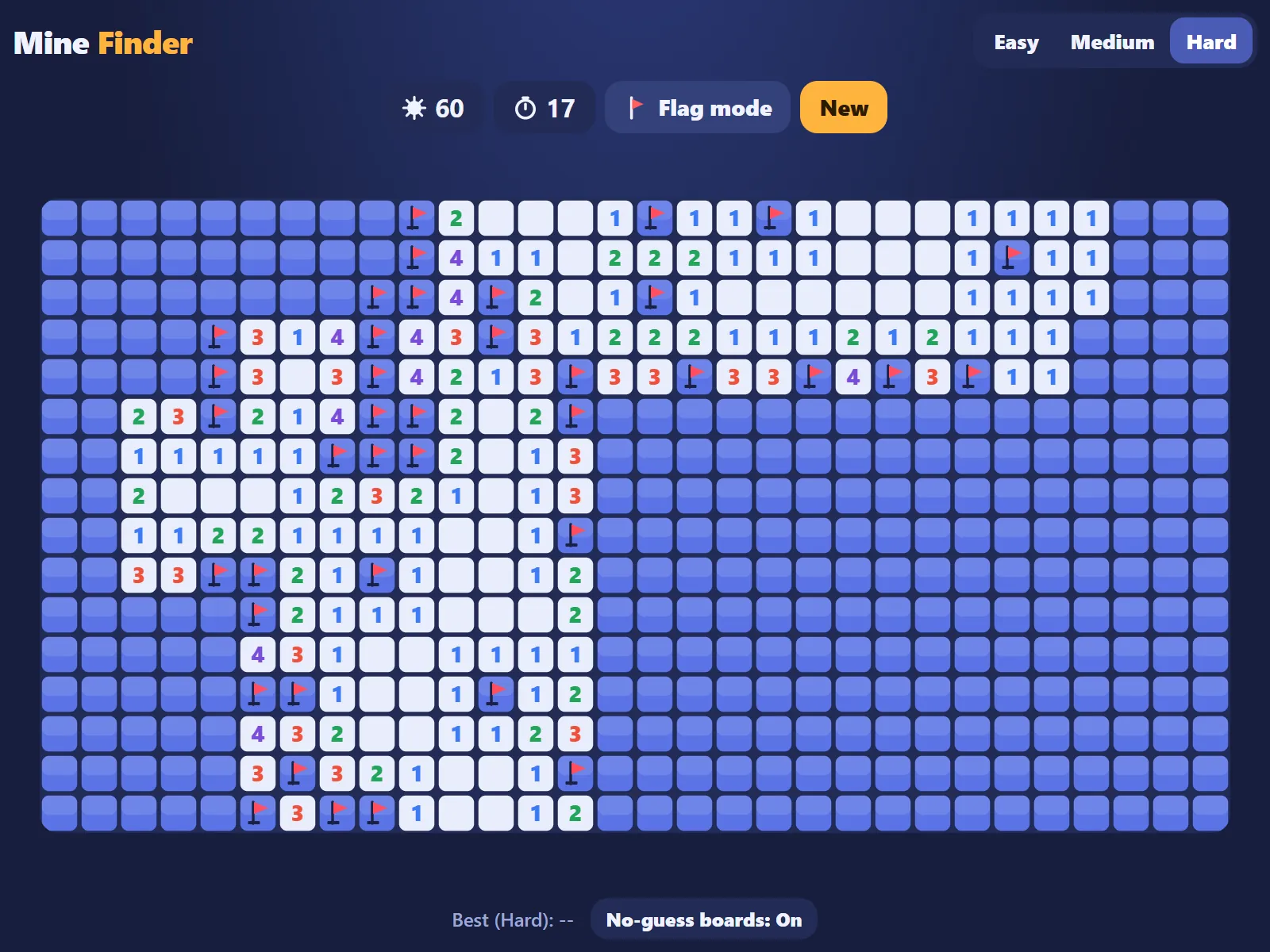
Mine Finder has a “No-guess boards” option that runs a small logic solver, which meant we could just measure it. We turned the option off, generated tens of thousands of ordinary random boards, and let the solver play each one from the first click.
Setup
Generator and solver were copied straight out of the page, with the game’s settings:
- Easy: 9×9, 10 mines
- Medium: 16×16, 40 mines
- Hard: 16×30, 99 mines
- The first click and the squares around it are always safe.
Each board got its first click on a random square. If the solver uncovered every safe square without choosing blindly, the board counts as “no guess needed.” If it got stuck, we recorded how much it had cleared. 20,000 boards per difficulty.
How many boards need a guess
| Difficulty | Mine density | Boards tested | Solved by logic alone | Needed at least one guess |
|---|---|---|---|---|
| Easy (9×9, 10) | 12.3% | 20,000 | 84.3% | 15.7% |
| Medium (16×16, 40) | 15.6% | 20,000 | 60.5% | 39.5% |
| Hard (16×30, 99) | 20.6% | 20,000 | 10.1% | 89.9% |
We ran everything a second time on fresh boards. The two runs matched within about half a percentage point on every row, so these hold to the nearest percent.
Hard is the one that surprised us. Roughly nine classic Hard boards in ten can’t be finished with these rules alone. If you lose a Hard game to a coin flip with no-guess turned off, the board is the likely culprit.
How far logic gets first
For boards that did need a guess, this is how much of the board (as a share of all safe squares) the solver had uncovered when it first got stuck:
| Difficulty | Boards that needed a guess | Average cleared | Median cleared | Stuck before 25% | Got past 90% |
|---|---|---|---|---|---|
| Easy | 3,134 | 75% | 96% | 19% | 65% |
| Medium | 7,899 | 79% | 98% | 19% | 73% |
| Hard | 17,971 | 64% | 84% | 26% | 44% |
There are two kinds of stuck board in here.
Most guess boards on Easy and Medium are nearly done when they go bad. The median Medium one gets 98% of the way and then stalls on the last few squares: two or three covered squares left, and the numbers around them fit more than one arrangement. That’s the familiar endgame standoff.
The other kind stalls right away. About one guess board in five on Easy and Medium, and one in four on Hard, gets stuck before a quarter of the board is open. The first opening and the numbers along its edge just don’t pin anything down.
First-click position
We also split results by where the first click landed. A corner click only guarantees a 2×2 safe patch instead of 3×3, and you can see it in the numbers. On Easy, 76.3% of corner starts (970 boards) were solvable by logic, against 85.5% of interior starts (12,142 boards). On Medium it was 48.4% of corner starts (343 boards) against 61.2% of interior starts (15,326 boards). The corner samples are small, so don’t lean on the exact figures, but the direction was the same on every difficulty. Click away from the edges.
Why Hard is so much worse
Density first. Hard has a mine in roughly one square in five; Easy, one in eight. More mines means bigger numbers and fewer zeros. Zeros are what open up their neighbors for free, so with fewer of them the cleared area grows in thin strips, with more ambiguous spots along the way.
Then size. A stuck point is something small and local, like two squares nobody can tell apart. A 480-square board has many more places for one of those to show up than an 81-square board does, and you need every one of them to come out clean.
Hard gets both at once. That’s how its solve rate ends up at 10% when Medium’s is 60%.
What the solver can and can’t do
“Solvable by logic” depends on which logic you allow. Mine Finder’s solver repeats these steps until the board is clear or none of them applies:
- Single-number rules. For each uncovered number, count its flagged neighbors. If the flags already match the number, every other covered neighbor is safe. If the number of covered neighbors equals the mines still needed, they’re all mines.
- Pairs of numbers. When neither rule fires, it compares every pair of numbers that share covered squares. If one number’s leftover mine count, minus the squares only it can see, equals the other number’s leftover count, then the squares only the first one sees are all mines and the squares only the second one sees are all safe. This is the subtraction behind the 1-2-1 and 1-2-2-1 patterns in our Mine Finder patterns guide.
- The mine counter. If every mine is flagged, all remaining covered squares are safe. If the covered squares left equal the mines left, they’re all mines.
If nothing fires, the board is stuck.
That’s about what a strong human player uses, but it isn’t everything. It never chains three or more numbers together, and it only uses the mine counter in those two all-or-nothing cases. Some boards it calls stuck could be cracked with deeper reasoning. Treat the “solved by logic alone” column as a floor. The real share of no-guess boards is somewhat higher, though not enough to change the picture.
When you play
On classic boards a forced guess isn’t a mistake, and on Hard it’s what normally happens. What you control is how late you guess and which square you pick.
So clear every other safe area first. Most guess boards are mostly solvable, a deduction somewhere else occasionally supplies the missing piece, and if the guess goes wrong you’ve at least lost late.
Then guess where it helps. The patterns guide covers how to find the safest square and why a guess that opens up new information beats one that doesn’t.
How the No-guess option works
No-guess boards are on by default. Mine Finder doesn’t create the board until your first click. Then it generates a random board with that square and its neighbors kept safe, runs the solver above starting from that exact click, and keeps the board only if the solver clears it completely. Otherwise it throws the board out and tries again.
Over 2,000 test runs per difficulty, that took 1.2 attempts on average on Easy, 1.65 on Medium and about 10 on Hard. The worst Hard case we saw needed 94 attempts and still finished in about 26 milliseconds on our test machine. The game allows the search 1.5 seconds. If it ever ran out, you’d get the last board generated, which might need a guess. In testing it never got close.
With no-guess on, the board you get can be cleared with the three kinds of reasoning above (the generator has a 1.5-second budget and would fall back to a plain random board if it ran out, which never happened in our 6,000 test boards), so if you’re stuck, something on the board is telling you the answer. The button for it sits under the board in Mine Finder. Turn it off and you’re back to the odds in the first table.