How Many Moves Should a Memory Game Take? We Ran 600,000 Games to Find Out
You finish a board in Pair Up in twelve moves. Is that good? On the 4×4 board the minimum is eight, one move per pair, but you only get eight if every blind guess happens to land. That’s luck, so it’s a bad thing to measure yourself against.
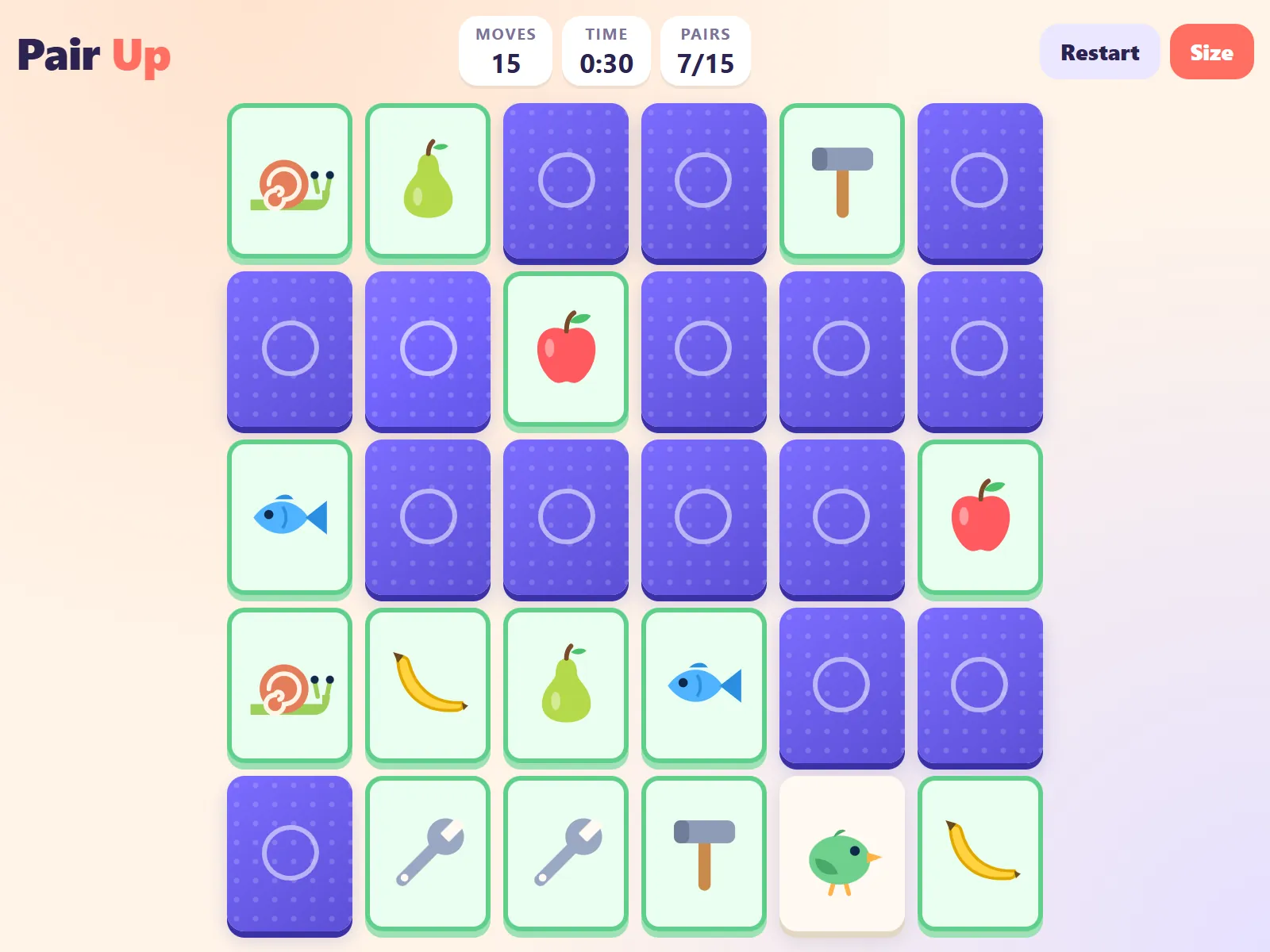
The number we wanted was different: how many moves does a player with perfect memory need? This player never forgets a card, never flips one they already know, and takes a match as soon as one is available. They can’t do anything about the shuffle. They just don’t waste flips. Get close to them and your memory is fine.
We couldn’t find that number for our board sizes anywhere, so we measured it.
The setup
We wrote a small simulation of that player and ran it for 200,000 shuffled games on each of the three Pair Up boards. It follows the strategy on our game page to the letter:
- If you know where both cards of a pair are, flip them. Guaranteed match.
- Otherwise, flip a card you’ve never seen.
- If its twin has been seen before, flip the twin. Match.
- If not, flip another unseen card. It might match by luck. If it doesn’t, you’ve learned two new positions, and sometimes the second card completes a pair you can collect next turn.
Two flips is one move, which is how the game counts it.
Results
| Board | Pairs | Flawless average | Best 10% | Worst 10% | Our 3-star mark | Flawless player gets 3 stars |
|---|---|---|---|---|---|---|
| Small (4×3) | 6 | 9.2 moves | 8 or fewer | 10 or more | 10 or fewer | 99% of games |
| Medium (4×4) | 8 | 12.4 moves | 12 or fewer | 13 or more | 13 or fewer | 96% of games |
| Large (6×5) | 15 | 23.7 moves | 23 or fewer | 25 or more | 24 or fewer | 84% of games |
So the twelve moves on Medium from the opening is right around what perfect recall gets.
The flawless player averages about 1.5 to 1.6 moves per pair. The ratio rises slowly with board size and levels off a bit above 1.6 on very large boards. Put roughly, every other pair costs one move spent learning positions, and no amount of memory gets that move back.
The spread is narrower than we expected. On Small, the flawless player’s results run from 6 moves (every guess right) to 11 at the worst, but 99% of games fall between 8 and 10. If your own scores jump around a lot from game to game, the shuffle probably isn’t the reason. Forgetting is.
The 3-star marks are strict, and we meant them to be. On Small and Medium, a game with no memory slips earns three stars almost every time. On Large, even flawless play misses about one game in six, because 15 pairs leave the shuffle more room to go against you. Three stars on Large is a good result by any measure.
Where the extra moves come from
When we compared the simulated player to how people actually play, us included during playtesting, nearly all the difference came from three habits.
Spending the second flip on a known card
You flip a new card. Its twin hasn’t shown up yet. Then for the second flip you pick a card you’ve already seen. That card can’t be the twin, or you’d have known where the twin was. You learn nothing from it, so half the move is gone. The flawless player always makes the second flip a new card.
Walking past a free pair
Sometimes the second flip shows a card whose twin you saw earlier. It doesn’t match your first card, the turn ends as a miss, and it’s easy to move on. But you now know where both halves of that other pair are. Take it on the very next turn, before newer cards push it out of your head. In the simulation, about one move in eight is one of these pickups, on every board size. Each one you miss costs at least one move later.
Losing the early cards
On a big board, the first cards you see have to stay in memory for a long time. By the time a twin turns up, ten other cards may have gone by. This is most of what makes Large hard. What helps:
- Flip in a fixed order. Go row by row from the top left. “Third card in row two” is easier to recall than a position you picked at random.
- Say it. “Key, top right” gives you the picture and the place, two things to remember instead of one.
- Use the color. Most Pair Up pictures are dominated by one color. When the exact picture slips, “something yellow near the middle” still narrows the search.
Grading yourself
Take your average over five games on one board size:
| Board | Excellent | Good | Room to improve |
|---|---|---|---|
| Small | 9–10 moves | 11–12 | 13+ |
| Medium | 12–13 | 14–16 | 17+ |
| Large | 23–25 | 26–30 | 31+ |
“Excellent” is at or very near the flawless player. Past that point, better scores are mostly the shuffle. If you’re in “Room to improve,” don’t speed up. Slow down and work on the first habit. Never using your second flip on a known card is the biggest single gain for most players.
Why the stars ignore the clock
People ask about this. Moves measure memory. Time mostly measures how fast you tap. Pair Up still saves your fastest time for each board size, so once your move counts sit in the “Excellent” band, the clock is something else to chase.
Start on the Small board in Pair Up and see if your five-game average comes in under 10.