Shelf Sort Strategy: Planning Around Back Rows and the Clock
The first two levels of Shelf Sort are a warm-up: six shelves, four sets of three, lots of time. On level 3 some shelves show a +1 badge, and the game changes. Matching what you can see is no longer the hard part. The hard part is the stuff behind it.
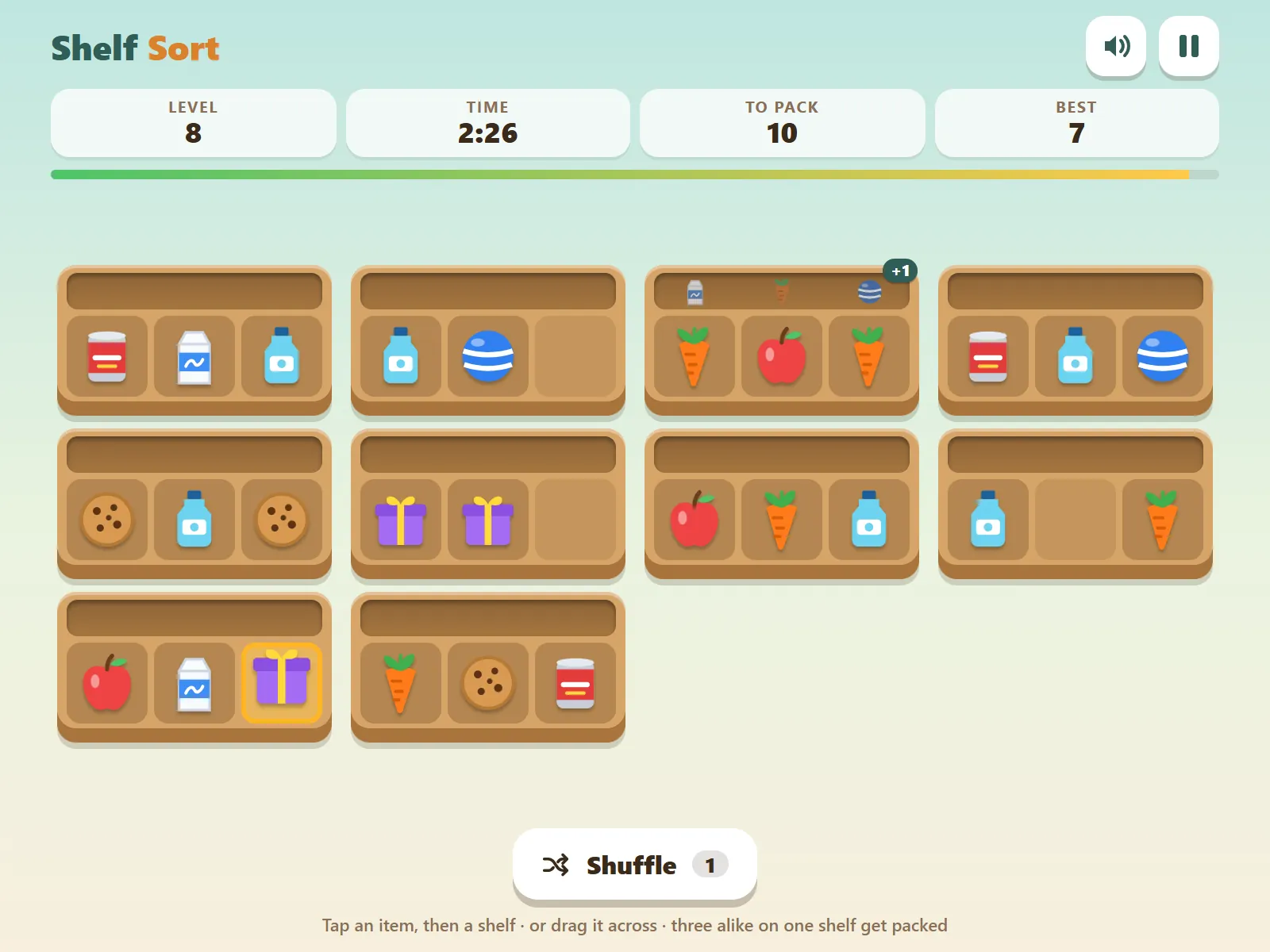
This post is about planning for those hidden rows. The basic rules are on the Shelf Sort page if you haven’t played yet.
Back rows, quickly
- Each shelf shows three front slots. You can only move front items.
- Some shelves have one or two more rows behind. The next row is drawn small and dimmed on the shelf’s back board, and the badge (+1 or +2) says how many rows are waiting.
- When all three front slots on a shelf are empty, the next row steps forward.
The last rule is the one that matters. The only way to get hidden goods into play is to empty their shelf, and you decide when that happens.
Count first
Before the first move on a new level, take five seconds and look. For each kind of item, how many are in front rows and how many are dimmed on back boards?
| Situation | What it means | What to do |
|---|---|---|
| All three copies are in front | A guaranteed set | Pack it early to free slots |
| Two in front, third in a back row | The set depends on emptying a shelf | Make emptying that shelf a priority |
| One or fewer in front | Not ready yet | Leave these items where they are |
The last row of that table is where boards go wrong. Moving those items around costs time and fills slots without getting you any closer to a pack.
Which shelf to open
When you have a choice, empty the shelf with the most useful back row. Check the dimmed items.
If the back row holds the third copy of a pair you already have in front, open it. You’ll pack almost right away.
If the back row holds things that match nothing in front, leave it for now. Opening it brings three orphans into play and takes up three slots you may need.
A +2 shelf gives you a new row now and another later. If the next row is useful, it’s a strong pick, because it keeps feeding you options.
In our playtesting, mid-level boards were lost to this more than to the clock. Someone opened the wrong shelf and the board filled with items that had no partners yet.
Keep a workbench
You need at least one shelf with free slots to move things through.
- Never fill your last free shelf with three different items. That’s the usual jam.
- A shelf you just packed becomes a new workbench, unless its back row steps forward and fills it again. On a deep shelf, check what’s coming forward before you pack.
- Two half-empty shelves beat one full and one empty. More shelves with space means more places to build sets.
The clock
Each level gives you 50 seconds plus 9 seconds per set to pack. A fixed buffer, then about 9 seconds a set.
Early on, the 50-second buffer is plenty. Spend part of it on that five-second look before your first move.
On big boards the buffer stops mattering much. From level 10 on there are a dozen or more sets, and you’re really racing the 9 seconds each one adds. A set that takes 20 seconds of shuffling items around puts you behind.
The timer turns red in the last ten seconds. If you’re nowhere near done by then, pack whatever is quickest. Every pack also frees slots for the next one.
The shuffle
You get one shuffle per level. It collects every item still on the shelves and deals them out again into a layout our solver has confirmed can be finished. If the board was completely jammed, it packs one set for you as well.
Since it’s a rescue, don’t spend it tidying a messy board. If you still have moves, you can probably work through the mess, and you’ll want the shuffle later.
Use it when the board is jammed or close to it. That’s when it does the most, since it may pack a set for you too. It’s also worth using when time is short and the board is badly tangled, because a fresh solvable layout can be quicker than untangling the old one.
A worked example
A six-shelf level. Front rows, with back rows in brackets:
- Shelf A: apple, apple, milk — [+1: cookie, apple, tea]
- Shelf B: cheese, milk, empty
- Shelf C: cookie, tea, cookie
- Shelf D: empty, empty, empty
Starting with the cookies is tempting, but the third cookie is on Shelf A’s back row. The third apple is back there too. Both stuck pairs point at the same shelf, so empty Shelf A.
- Move milk from A to B → B now has cheese, milk, milk.
- A still holds two apples. Move them to D, the workbench → A’s front row is empty and its back row steps forward: cookie, apple, tea.
- Move A’s apple to D → D packs three apples.
- Shelf C is full (cookie, tea, cookie), so make room: move C’s tea into A’s free slot, then move A’s cookie into the slot that just opened on C → C packs three cookies.
Two stuck pairs became two packs in a few moves. Starting on B or C would have moved items around and packed nothing.
Checklist
- Look before you move.
- Open shelves whose back rows finish your pairs.
- Keep a workbench.
- The clock is 50 seconds plus 9 per set.
- Save the shuffle for real jams.
A solver checks every Shelf Sort level before it reaches you, so there is always a way through. Try it now →