How Hard Is Each Color Pour Level? We Solved the First 100
Color Pour builds each level from its level number, so level 30 is the same board for everyone. Fixed boards can be measured. We wanted to know how many pours each level really needs, how many ways there are to wreck it, and how far you’d get by pouring whatever happens to be legal.
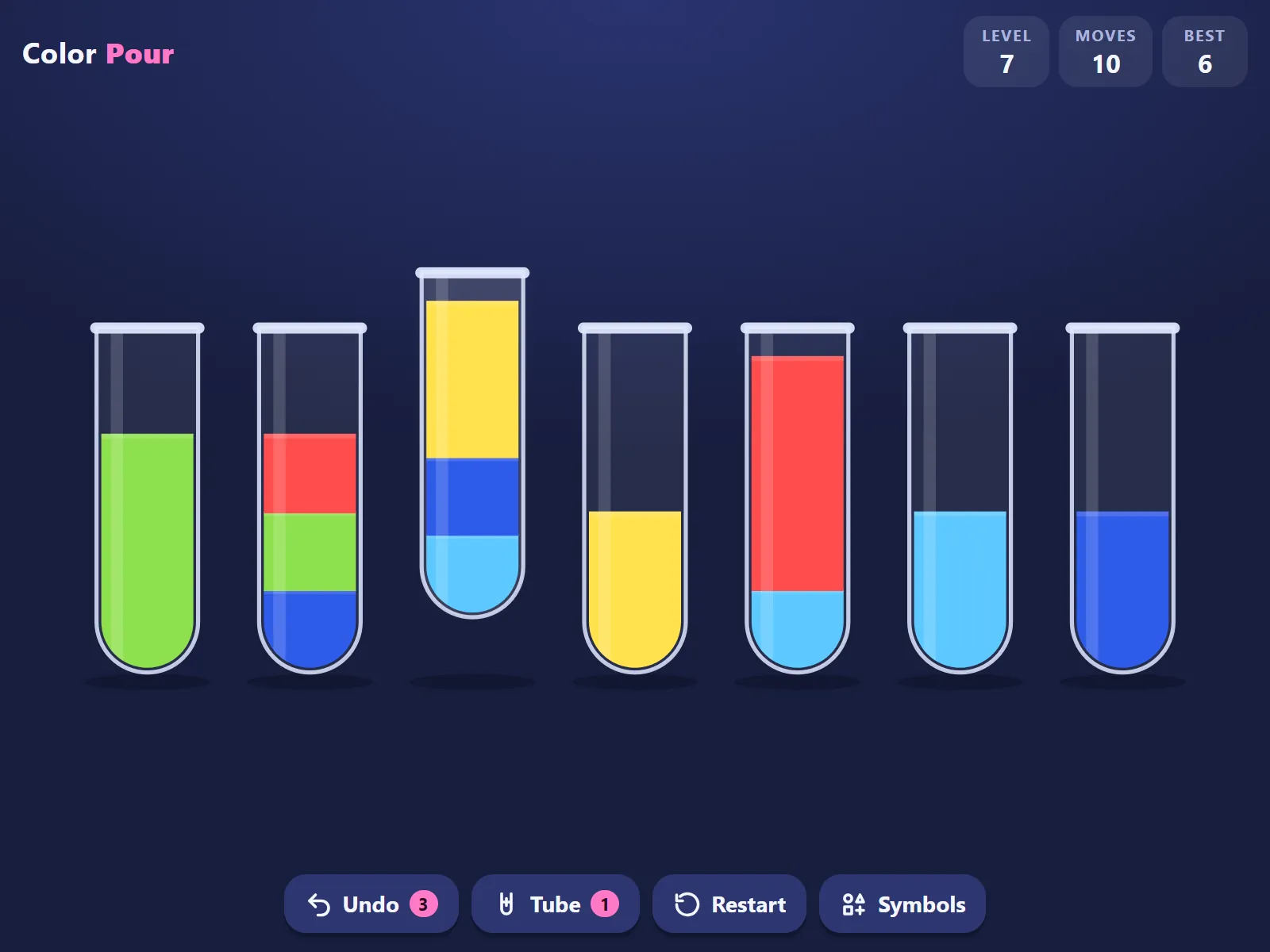
We lifted the level generator and pour rules out of the game, ran them in a script, and solved the first 100 levels completely.
Method
The level recipe is simple. Level 1 has 3 colors, and one more color is added every three levels until level 28 hits the cap of 12. There are always two more tubes than colors. Each tube holds four layers, and each color has exactly four layers. A pour moves the whole same-color block from the top of a tube, as much of it as fits.
For every level we explored every position reachable from the starting board, counting two positions as one if they differ only in which tube is where. From that we got:
- Minimum pours: the true shortest solution, found by breadth-first search. Proven, not estimated.
- Dead positions: positions you can reach but can never solve from, whatever you do next.
- Trap openings: first pours that already make the level unsolvable.
- Random play: 2,000 attempts per level by a “player” that picks uniformly among all legal pours, with no undo and no extra tube, until the level is solved or becomes unsolvable.
The search leaves out the three undos and the one extra tube the game gives you. Those are for getting out of trouble. We wanted the difficulty of the bare puzzle.
Results by level band
| Levels | Colors / tubes | Reachable positions | Minimum pours | Dead positions (avg) | Random play solves |
|---|---|---|---|---|---|
| 1–3 | 3 / 5 | 158–245 | 9–10 | 0% | 100% |
| 4–6 | 4 / 6 | 393–922 | 11–14 | 0% | 98% |
| 7–9 | 5 / 7 | 1,208–2,517 | 14–16 | 0.3% | 98% |
| 10–12 | 6 / 8 | 3,199–4,171 | 19–21 | 3% | 75% |
| 13–15 | 7 / 9 | 3,662–4,463 | 20–23 | 10% | 45% |
| 16–18 | 8 / 10 | 5,907–13,721 | 23–27 | 12% | 31% |
| 19–21 | 9 / 11 | 9,497–28,545 | 29–30 | 17% | 19% |
| 22–24 | 10 / 12 | 19,230–36,034 | 28–32 | 17% | 9% |
| 25–27 | 11 / 13 | 19,222–35,158 | 31–37 | 35% | 6% |
| 28–100 | 12 / 14 | 4,523–99,741 | 33–42 | 33% | 2.8% (median 0.8%) |
“Dead positions” is the share of all reachable positions that can no longer be solved, averaged over the band. “Random play solves” is the random pourer’s average success rate.
Through level 9 there’s almost nothing to fall into. Level 5 is the first level with any dead position, and it has exactly one out of 922. You can pour more or less anything and still win, which is fine while you’re learning where to tap.
Levels 10 to 15 are where the random pourer drops from near-perfect to about a coin flip. The rules don’t change. There are just more colors fighting over the same two empty tubes.
From level 28 on, random pouring almost never works. On 39 of the 73 twelve-color levels, it solved fewer than 1% of attempts. When it failed, it had usually made the level unsolvable within its first eight pours, well before the board looked crowded.
Specific levels
Level 14 has 7 colors, same as 13 and 15, but the random pourer solved it 13% of the time, against 73% for level 13 and 50% for level 15. If 13 went by easily and you’ve restarted 14 three times, it’s the level.
Level 26 is the hardest level before the 12-color stretch on our measures. 54% of its 33,113 reachable positions are dead, its shortest solution is 37 pours, and random play solved it in 2 of 2,000 attempts.
Levels 32 and 54 have the longest shortest solutions in the first 100, at 42 pours each.
Level 72 is the tightest board we found. Only 4,523 positions can be reached at all, and 70% of them are dead. Six of its twelve possible opening pours lose immediately. Random play went 0 for 2,000.
Going the other way, level 44 (33 pours minimum) and level 94 (36 pours) are roomy for 12 colors. Random play solved them 22% and 35% of the time.
What makes a level hard
More colors is the main thing: more layers competing for the same space. But the 12-color levels still differ a lot from each other, and here the numbers point somewhere specific.
Solution length isn’t the main problem. Across the 12-color levels, minimum pours only loosely tracked how often random play failed. A 40-pour level with room to move is easier to finish than a 36-pour level full of dead ends.
The share of dead positions was the better predictor. The hard levels are narrow rather than long. Most ways forward lead somewhere you can’t get out of, and you usually find out several pours too late.
What to do with this
The first pour is almost always safe. The second and third are where it goes wrong. At the start every tube is full, so all you can do is pour some tube’s top block into an empty one. Across levels 28–100, only 41 of the 876 possible opening pours (under 5%) were traps, and 52 of those 73 levels had none. Two pours in, about a quarter of the distinct positions you can reach are already dead. Pours two through eight are where the random pourer kept losing.
There’s no single right opening. On a 12-color level, 5 or 6 of the 12 opening pours start a shortest-possible solution. Save the thinking for what goes into the second empty tube. That’s usually the decision that closes the level off.
12-color levels take 33 to 42 pours. High 30s or low 40s is close to optimal. If you’re past 60 and still going, you’re probably moving the same layers back and forth. The clear screen shows your move count, and it adds “without undo” if you didn’t touch it. An undo counts as a move, too.
Restart early. Mistakes tend to sink a level in the first eight pours, so a level that feels wrong at move ten may already be gone. The game’s dead-end check will tell you when it can prove a position is unsolvable. If you see it coming yourself, restarting costs fewer moves than digging.
Our liquid sort solving techniques post covers the habits that keep you out of dead positions: keeping empty tubes free, pouring onto matches first, counting how deep each color is buried. This one is about where the difficulty sits.
Caveats
These numbers use the base rules only. With undo and the extra tube, real play is more forgiving than the random pourer suggests. Random-play rates come from 2,000 attempts per level, so a difference of a percent or two between levels is noise. The random pourer isn’t meant to model a person. Anyone looking one move ahead does far better. It measures how hard a level punishes moves made with no plan.
To check yourself against the table, count your pours on level 14 and level 26 in Color Pour.