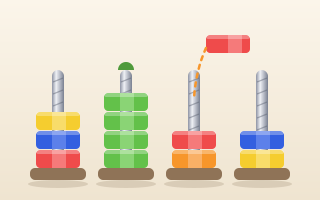
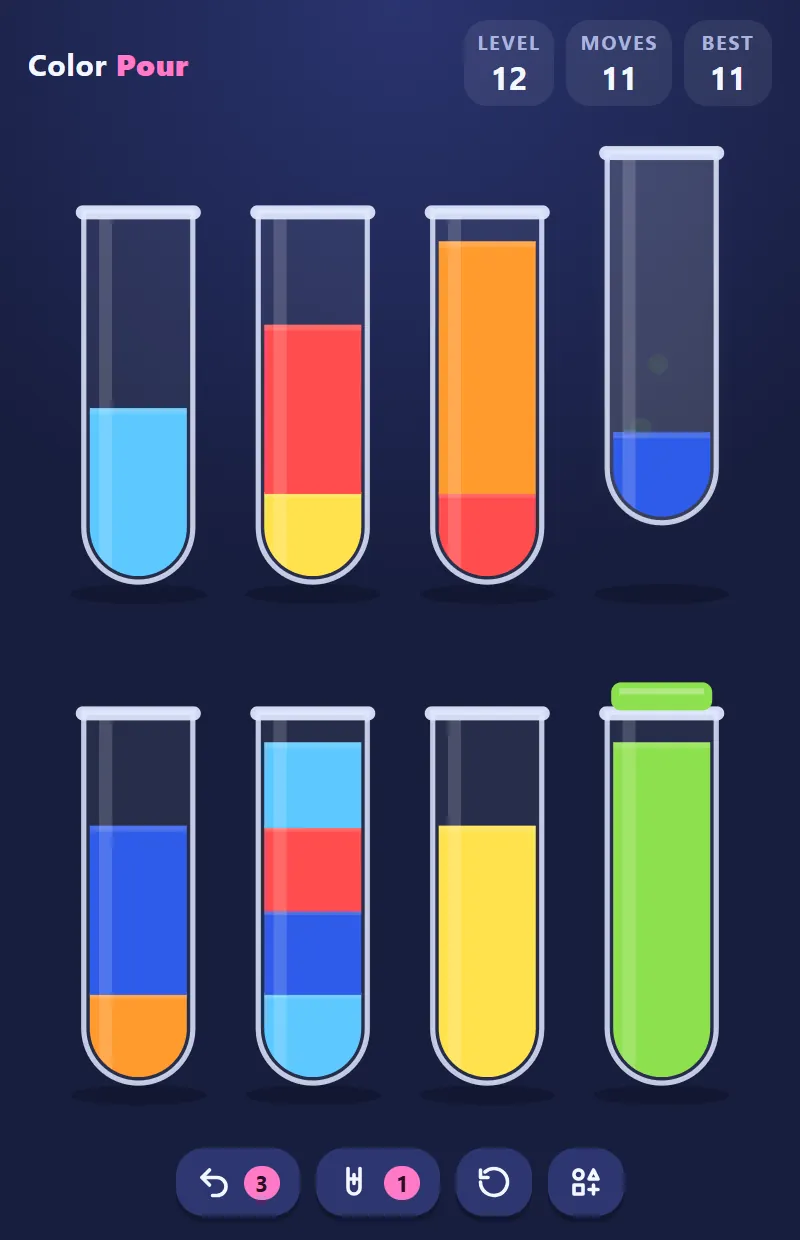
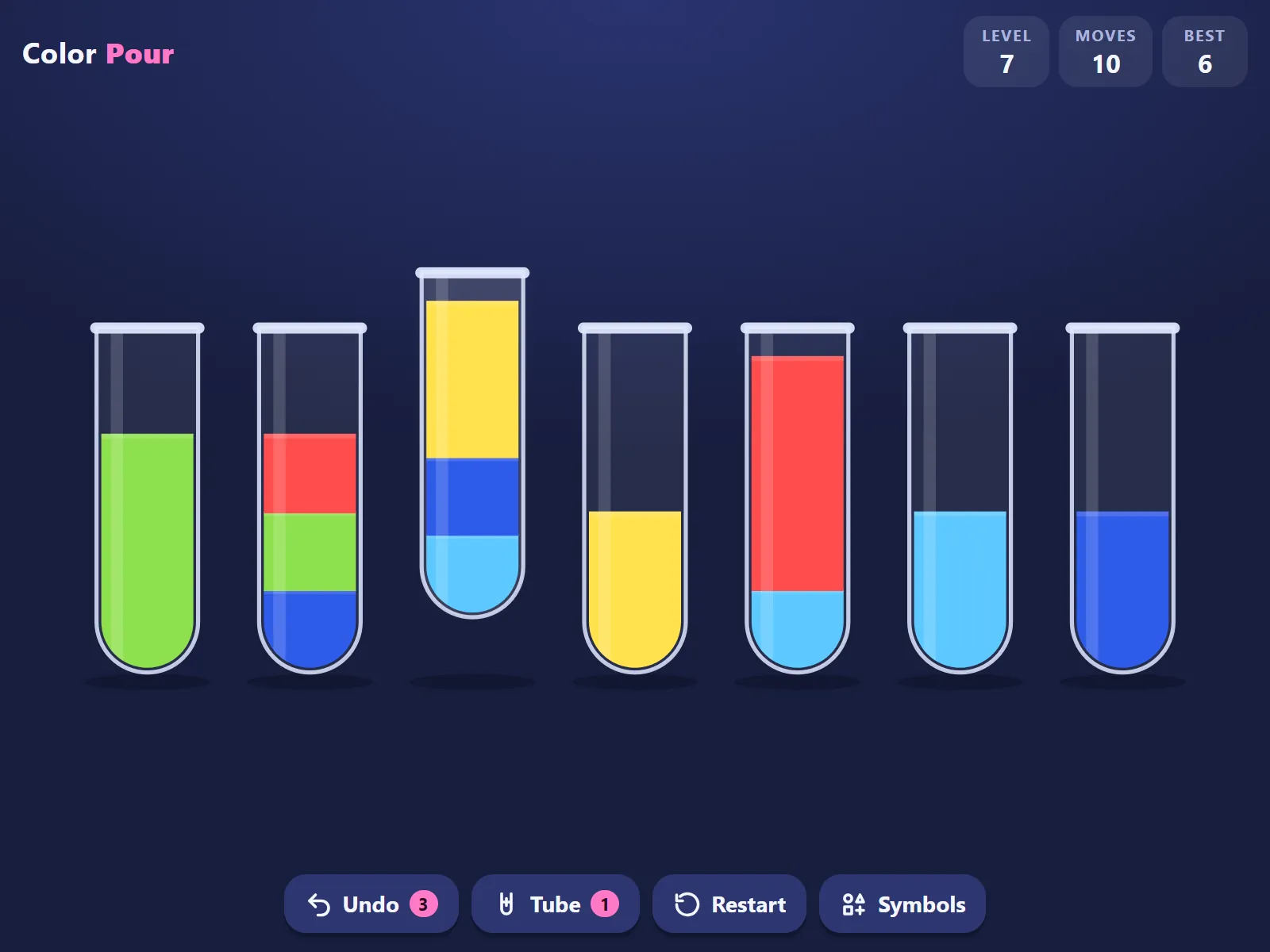
Color Pour is a liquid sort puzzle. Each tube holds up to four layers of colored liquid, the colors start out mixed, and you pour them back and forth until every tube is either empty or four layers of one color. No timer, no lives. A level ends when you finish it.
Pouring rules
Tap a tube to lift it. Empty tubes can’t be lifted; they just wobble at you. Then tap the tube you want to pour into.
A pour is allowed when the target is empty, or when its top layer matches the color you’re pouring and it still has room. Whatever matching block sits on top of the lifted tube pours at once, as much as fits. Three red layers into a tube with one free space: one layer moves, two stay.
If the pour isn’t allowed, the lifted tube shakes and your selection jumps to the tube you tapped, on the theory that you probably meant to pick that one up instead.
A tube holding four layers of one color gets a colored cap. Cap every color and the level is done.
Every pour counts as a move. So does every undo, which seems fair.
Helpers
| Helper | Uses per level | What it does |
|---|---|---|
| Undo | 3 | Steps back one pour |
| Extra tube | 1 | Adds one empty tube for the rest of the level |
| Restart | Unlimited | Resets the level and refills both helpers |
Undo won’t take away an extra tube you’ve added. It rewinds the liquid, and the tube stays.
On a keyboard, 1 to 9 jump straight to a tube and 0 picks the tenth. Z and Backspace also undo.
Where the levels come from
Every level is generated from its level number, so level 12 is the same level 12 for everyone, every time. The generator shuffles the layers, then rejects layouts it doesn’t like: any tube that starts already finished, or too many same-color layers already sitting on top of each other (it allows half the number of colors, at least one). Whatever survives goes to a solver, which has to find a complete solution before you ever see the level. We also ran the first 200 levels through a second, independent solver. All 200 were solvable.
The ramp is slow on purpose. Levels 1 to 3 have three colors, and one more color joins every three levels until level 28, which has twelve. That’s where it stops growing. You always start with two empty tubes, so a twelve-color level puts fourteen tubes on the board. There’s no last level. Your current level and best cleared level are saved in your browser.
Dead ends
After each pour, the game quietly asks the solver whether the position can still be won. If it proves you’re stuck, it says so, tells you whether an extra tube would rescue things, and offers Undo, the extra tube, or a restart. The check has a cap on how long it searches, so on the biggest boards it only speaks up when it’s sure. Silence doesn’t guarantee you’re fine.
Symbols
Some of the twelve colors are close enough that they can be hard to tell apart, depending on your eyes and your screen. Turn on Symbols (or press S) and each color also gets its own mark on every layer: circle, triangle, star, heart and so on.
Playing well
Empty tubes are the scarce thing. An empty tube accepts any color, which makes it the most flexible spot on the board. Pour into one when you’re starting a color you can finish soon. Using it as a place to park things is how boards lock up.
Matching color first. Red onto red costs nothing. The same red into an empty tube spends flexibility you may want in five moves.
Find all four layers before you start a color. Every color has exactly four. If all four are near the tops of their tubes, that’s a good first target. If one is at the bottom of a full tube, leave that color for later.
Ask what a pour covers. Pouring blue on top of the only reachable yellow means moving that blue again before you can get to the yellow.
Empty a whole tube. A tube you’ve emptied is as good as an extra tube. Often the best move is to dig out the tube with the fewest layers, even if nothing finishes right away.
Undos are for misclicks. You have three. Testing ideas with them goes badly. The extra tube does the most good late, when one color is trapped under another.
A worked example
A tiny two-color position, smaller than any real level, listed bottom to top:
| Tube | Contents |
|---|---|
| A | red, yellow, red, red |
| B | yellow, yellow, red, yellow |
| C | empty |
| D | empty |
Red has three layers in A and one in B. Yellow has one in A and three in B.
- Pour A into C. Both reds on top of A go together. C has two reds, A shows yellow.
- Pour B into A. B’s top yellow lands on A’s yellow. A is red, yellow, yellow.
- Pour B into C. B’s red joins the others. C has three reds, B is down to two yellows.
- Pour A into B. Both yellows move and B becomes four yellows. Capped.
- Pour A into C. The last red finishes C.
Five pours. D never got used. Step 2 is the one to notice: yellow onto yellow was free, and putting it in D instead would have spent the spare tube for nothing.
FAQ
Is every level really solvable?
Yes. A level is built from a seed and checked by the solver first. If the solver doesn’t find a solution within its budget, the game tries a different layout for that level number.
Does using undo or the extra tube hurt my progress?
No. A cleared level counts the same either way. The win screen just mentions it when you solved one without undo.
Can I replay an earlier level?
After clearing a level, Play again replays it. The start screen also has a button to jump back to level 1, and your saved progress stays put.