Why Sorting Puzzles Are So Satisfying
Sorting puzzles are a whole family of games built on one of the simplest ideas there is: here’s a mess, make it tidy. You pour colored liquids until each tube holds one color, stack nuts until each bolt carries one shade, or arrange groceries until matching items sit together on a shelf.
We’ve built three of them here: Shelf Sort, Color Pour and Bolt Sort. While designing them we spent a lot of time on one question: why do these games feel so good to play? Here’s what we learned, in general terms that apply to the whole genre.
The loop: chaos in, order out
Every sorting puzzle has the same basic shape. The board starts mixed up. Each move is small and easy to understand. And the end state is obvious at a glance: everything grouped, everything in its place.
That clarity matters. In many puzzles you aren’t sure what “solved” looks like until you get there. In a sorting puzzle you know from the first second, and you can see your progress with every move. A tube that was four colors is now two. A shelf that was a jumble now holds a matching pair. Watching disorder turn into order a little at a time is satisfying in the same way that folding laundry or clearing a desk is. It’s a small, visible improvement you made yourself.
Small moves, big consequences
The rules of a sorting game fit in a sentence or two, but those rules have teeth. Most sorting puzzles share a handful of constraints:
- You can only reach the top. Only the top layer of a tube, the top nut on a bolt, or the front row of a shelf can move.
- Capacity is limited. A tube holds four layers, a bolt holds a fixed number of nuts, a shelf has three slots.
- Where you can move depends on what’s there. Liquid usually only pours onto the same color or into an empty tube, and nuts often follow the same rule.
These constraints turn a simple goal into real planning. Moving one thing often means first moving the thing on top of it, and that thing needs somewhere to go. The satisfying moment isn’t just the final sorted state. It’s when a sequence you planned three moves ahead actually works.
Empty space is the real resource
Players tend to think of these games as being about colors or items. In practice, most of them are about space. An empty tube, a bare bolt or a clear shelf is what lets you untangle everything else.
This gives sorting puzzles a nice push and pull. Filling empty space feels like progress, but it also takes away your flexibility. Good players learn to treat an empty container like money in the bank: spend it when it buys you something, and try to get it back quickly.
That’s also why many sorting games offer an “extra container” or “shuffle” helper. It’s a pressure valve. When you’ve boxed yourself in, it gives you a way out that feels generous rather than like starting over.
Three flavors of the same idea
The genre has several well-known variations, and each one tweaks the core loop in a way that changes how it feels.
Goods sorting (match three on a shelf)
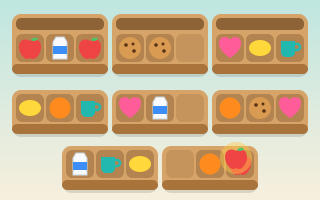
In goods sorting, items sit on shelves and you move them one at a time. Three matching items on one shelf clear away. The shelves often hide more stock in rows behind the front one, so clearing a shelf reveals what comes next.
This variation adds discovery. You don’t know everything at the start, and each cleared shelf brings a small surprise. It also usually adds a clock, which changes the mood from calm to lightly urgent. In our Shelf Sort, the back rows are shown dimmed so you can plan a little, but you still have to empty the front row before they step forward.
Liquid sorting (pour into tubes)
Liquid sorting is the calmest version. Tubes hold stacked colored layers, and pouring moves the whole top color at once, as much as fits. There’s no clock in most versions, and the pour itself is a pleasant little animation.
The interesting twist is that a pour moves several units at once. That makes planning feel different from moving single items: pouring into a tube that is too full splits a color, and splits are what make levels hard. Color Pour is our take on this.
Screw sorting (nuts on bolts)
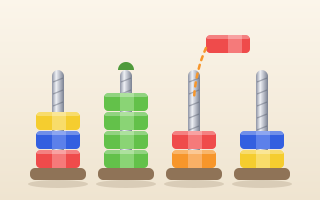
Nut-and-bolt sorting feels physical. You unscrew nuts and thread them onto other bolts, and the tactile theme makes every move feel like handling a real object. The logic is close to liquid sorting, but the mechanical look and sound give it a different, workshop-like character. See Bolt Sort.
Why the feedback matters so much
A sorting puzzle with the same rules can feel great or flat depending on its feedback. Some things we learned while building ours:
- Every move should be acknowledged. An item that lands with a little bounce, a liquid that sloshes, a nut that spins as it travels: these small responses tell you the game heard you.
- Completion should be a celebration. When a set is finished, the game should mark it clearly with a pop, a sound or a burst of sparkles. This is the moment the player worked for.
- Mistakes should be gentle. Trying to put an item on a full shelf should give a small “no” wiggle, not a punishment. Sorting puzzles are about calm focus, and harsh feedback breaks that.
- Progress should be counted. A “sets left” counter or a row of finished containers turns a vague sense of tidying into a clear goal you can see shrinking.
Fairness: the hidden requirement
There’s one more thing that makes sorting puzzles satisfying, and players only notice it when it’s missing: the level has to be winnable.
Randomly scrambling a board can easily produce a position with no solution, and nothing is more frustrating than spending five minutes on a puzzle that could never be solved. Well-made sorting games guard against this. They either build levels backward from a solved state using only legal moves, or they generate a scramble and have a solver prove it can be finished before showing it to you.
All three of our sorting games do one or the other. That promise changes how you play. When you’re stuck, you know the problem is your plan, not the puzzle, and that’s what makes finally solving it feel earned.
Why they’re perfect for short breaks
Finally, sorting puzzles fit neatly into small gaps in the day. A level takes a few minutes, the rules need no explanation, and you can stop at any point. The mental effort is real but gentle: enough to pull your attention away from whatever you were doing, not so much that it feels like work.
That mix of a clear goal, visible progress, meaningful constraints and a guaranteed fair ending is why this simple idea keeps working. If you’d like to try all three styles, start with Shelf Sort for the timed shelf version, Color Pour for calm pouring, and Bolt Sort for the workshop take.