Which Puzzle Game Fits Your Break? A Guide by Time and Mood
Not every break is the same. Sometimes you have two minutes between meetings and want something that asks nothing of you. Sometimes you have half an hour and want to get properly absorbed in a problem. Choosing the wrong game for the moment is how a “quick round” turns into a frustrating one, or how a relaxing evening turns into staring at a Sudoku you don’t have the energy for.
We build short puzzle games for a living, and we think about session length and mental load for every one of them. Here’s how we’d match the games on this site to the time and mood you have.
If you have 2–5 minutes
Short breaks call for games where a round is naturally short and there’s no penalty for stopping mid-way.
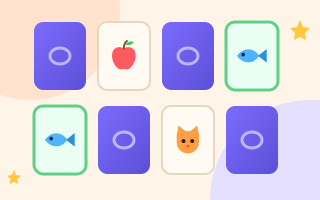
- Pair Up on the small board is the shortest complete game on the site. A 4×3 grid takes most people well under two minutes, and you get a clear finish with a star rating.
- Color Pour and Bolt Sort are level-based, and early and mid levels take a minute or two each. Because every level is solvable and self-contained, you can play exactly one and close the tab.
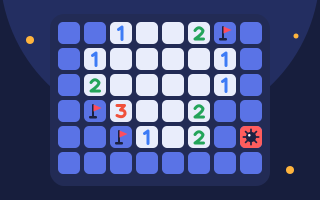
- Mine Finder on Easy (9×9, 10 mines) is a classic quick game. Experienced players finish it in under a minute.
What these have in common is a natural stopping point. That matters more than it sounds: a game without one will quietly eat your whole break.
If you have 10–20 minutes
With a bit more time, you can pick games that build up over a session.
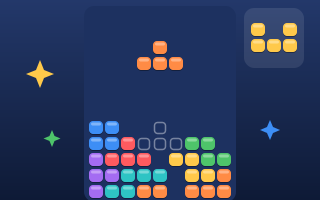
- Block Drop gets faster as you clear lines, so a good run builds real tension. A single game can last from three minutes to twenty depending on how clean your stacking is.
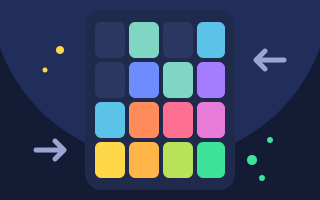
- Merge 2048 rewards a steady plan over many moves. Reaching the 2048 tile usually takes a focused 10–15 minutes once you know the corner method.
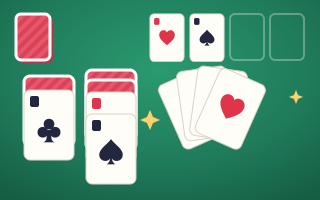
- Klondike Solitaire is the classic “one more game” card game. A typical deal takes five to ten minutes, and the draw-3 option makes it noticeably harder.
If you want to switch your brain off
Some games are about flow rather than thinking. The rules are simple, the feedback is satisfying, and your hands can do much of the work.
Sorting games — Color Pour, Bolt Sort and Shelf Sort — are the best fit here. The goal is always visible (everything in its place), progress is obvious, and the finishing move comes with a small payoff. Early Block Drop levels work too: the speed is gentle, and clearing lines has a rhythm to it.
If you want to think hard
When you actually want a challenge, pick a game where logic, not luck, decides the outcome.
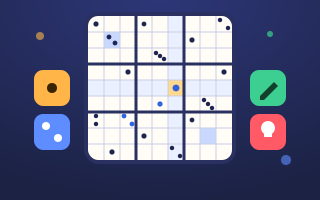
- Sudoku on Hard or Expert needs real techniques, like pairs, pointing pairs and X-wings. Every puzzle has exactly one solution, so you never have to guess.
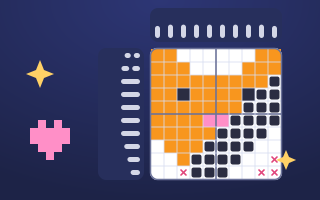
- Pixel Logic 15×15 puzzles are pure deduction too, and you get a picture at the end as a reward.
- Mine Finder on Hard (99 mines) is a long chain of deductions. With the default “no-guess boards” option, every board can be cleared by logic alone; switch it off for the classic experience, where spotting a truly forced guess — and making the best one — becomes part of the skill.
A quick reference
| Game | Typical round | Mental load | Luck involved |
|---|---|---|---|
| Pair Up (small) | 1–2 min | Low | Little (memory) |
| Color Pour / Bolt Sort | 1–3 min per level | Low to medium | None |
| Shelf Sort | 1–3 min per level | Low to medium | None |
| Mine Finder (Easy) | 1–3 min | Medium | None with no-guess boards |
| Block Drop | 3–20 min | Medium, rising | Piece order |
| Merge 2048 | 10–20 min | Medium | New tile placement |
| Klondike Solitaire | 5–10 min | Medium | The deal |
| Sudoku (Hard) | 10–30 min | High | None |
| Pixel Logic (15×15) | 10–25 min | High | None |
A note on stopping
The best break is one you come back from refreshed. Every game here saves your best score or progress in your browser, so there’s no reason to push through one more round just to avoid losing something. Finish the level, close the tab, and pick it up next time.